Espresso Chart
Espresso drinks are built from the same few ingredients in different proportions. The chart shows what goes into each classic drink and its typical size, and the calculator helps you dial in the shot itself: enter your dose of ground coffee and your target ratio to get the yield to aim for, then use the shot time and taste to adjust your grind.
Espresso Chart & Barista Kit
Printable barista kit: espresso drinks chart poster, espresso dial-in log (Excel), milk steaming guide, café menu template and coffee tasting notes sheet.
- Drinks chart (PDF)
- Dial-in log (XLSX)
- Milk guide (PDF)
- Café menu (DOCX)
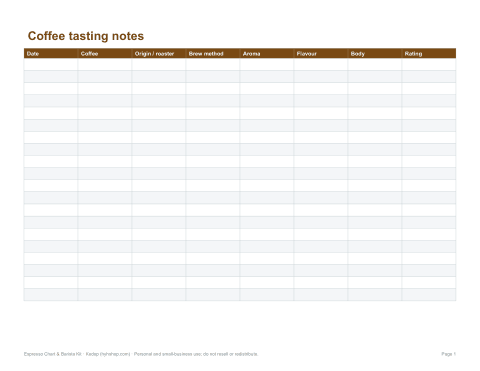
- Tasting notes (PDF, XLSX)
Formats: PDF, XLSX, DOCX. Instant download after payment (link valid 72 hours, up to 5 downloads). AI-assisted: the templates were drafted with AI help and reviewed and laid out by Kedop.
$5.00 USD, one-time
Secure card checkout by Stripe. Full refund within 7 days — see the refund policy and license.
Espresso brew ratio calculator
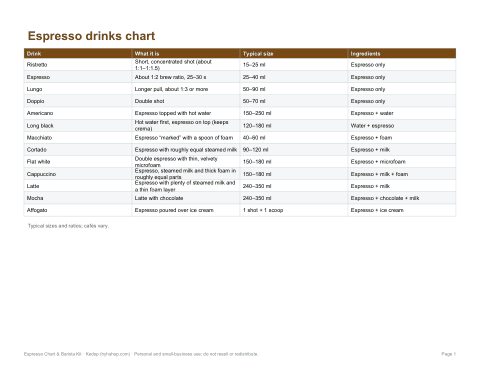
Espresso drinks chart
| Drink | What it is | Typical size | Ingredients |
|---|---|---|---|
| Ristretto | Short, concentrated shot (about 1:1–1:1.5) | 15–25 ml | Espresso only |
| Espresso | About 1:2 brew ratio, 25–30 s | 25–40 ml | Espresso only |
| Lungo | Longer pull, about 1:3 or more | 50–90 ml | Espresso only |
| Doppio | Double shot | 50–70 ml | Espresso only |
| Americano | Espresso topped with hot water | 150–250 ml | Espresso + water |
| Long black | Hot water first, espresso on top (keeps crema) | 120–180 ml | Water + espresso |
| Macchiato | Espresso “marked” with a spoon of foam | 40–60 ml | Espresso + foam |
| Cortado | Espresso with roughly equal steamed milk | 90–120 ml | Espresso + milk |
| Flat white | Double espresso with thin, velvety microfoam | 150–180 ml | Espresso + microfoam |
| Cappuccino | Espresso, steamed milk and thick foam in roughly equal parts | 150–180 ml | Espresso + milk + foam |
| Latte | Espresso with plenty of steamed milk and a thin foam layer | 240–350 ml | Espresso + milk |
| Mocha | Latte with chocolate | 240–350 ml | Espresso + chocolate + milk |
| Affogato | Espresso poured over ice cream | 1 shot + 1 scoop | Espresso + ice cream |
Sizes and ratios vary between cafés, countries and coffee traditions — these are typical, not rules. The cup diagram in the calculator shows the approximate layers of each drink.
The brew ratio
An espresso recipe starts with the dose (grams of ground coffee in the basket) and the yield (grams of liquid espresso in the cup). The ratio between them shapes the shot: around 1:2 — for example 18 g in and 36 g out in 25–30 seconds — is a widely used starting point. Shorter ratios (ristretto) taste thicker and more intense; longer ratios (lungo) are lighter and can become bitter. Weigh the yield on a scale rather than judging by volume, because crema makes volume misleading.
Dialling in: grind, time and taste
| What you notice | Likely cause | Try |
|---|---|---|
| Sour, sharp, thin; shot runs fast | Under-extraction | Grind finer or increase yield |
| Bitter, harsh, dry; shot runs slow | Over-extraction | Grind coarser or reduce yield |
| Weak but not sour | Low dose or ratio too long | Increase dose or shorten ratio |
| Channelling (spurts, uneven flow) | Uneven puck prep | Distribute grounds evenly and tamp level |
| Balanced, sweet | Good extraction | Write down the recipe |
Change one variable at a time, usually the grind first. Freshly roasted beans (about 5–30 days after roasting) behave differently from older coffee and may need grind adjustments as they age.
How to use the calculator
- Enter your dose — the weight of ground coffee in the basket.
- Pick a target ratio; the calculator shows the yield to aim for and a typical time range.
- Pull the shot, weigh the yield and time it, and enter both to see your actual ratio and flow rate.
- Choose how it tasted to get an adjustment suggestion.
- Pick a drink to see its build and typical size.
Milk for espresso drinks
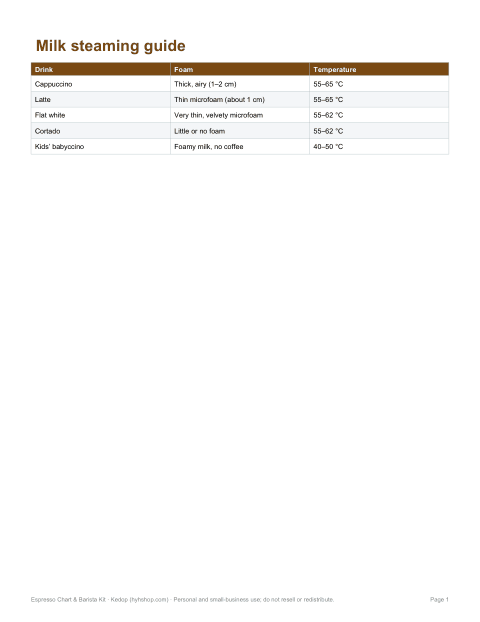
- Steam cold milk to about 55–65 °C (130–150 °F); hotter milk loses sweetness.
- Cappuccino needs more air (thicker foam); flat whites and lattes need less (silky microfoam).
- Whole milk foams richly; many oat and soy “barista” versions are made to foam well.
- Swirl and tap the jug to remove big bubbles before pouring.
- Pour latte art with microfoam that looks like wet paint.
Worked example
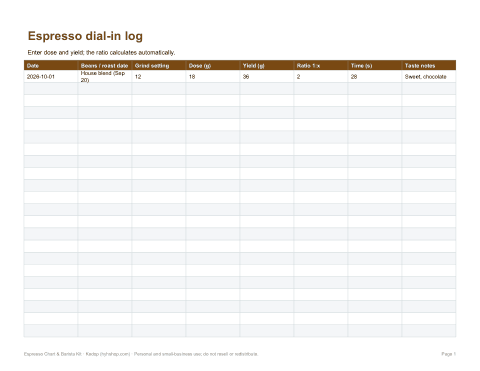
With an 18 g dose and a 1:2 ratio, the calculator targets 36 g of espresso in 25–30 seconds. Your first shot yields 36 g in 19 seconds and tastes sour, so it recommends grinding finer. The next shot runs 28 seconds and tastes sweet and balanced — that becomes your recipe. For a flat white, pour that double shot and top it with about 120 ml of velvety microfoam.
Espresso around the world
In Italy, a caffè is a single espresso, usually drunk quickly standing at the bar, and cappuccino is mostly a morning drink. Australia and New Zealand popularised the flat white and the long black. In Spain a cortado is a small espresso with a splash of milk; in Portugal a galão is a tall glass of milky coffee. Café menus differ, so ask if you’re unsure what you’ll get.
What the printable pack includes
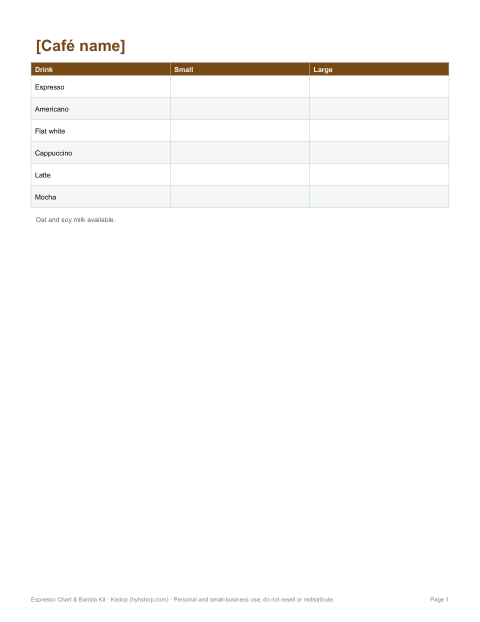
A printable espresso drinks chart poster, a dial-in log for recording dose, yield, time and taste, a milk steaming guide, a café menu template and a coffee tasting notes sheet.
Frequently asked questions
What is the standard espresso ratio?
About 1:2 — for example 18 g of coffee to 36 g of espresso — in 25–30 seconds.
What is the difference between a latte and a cappuccino?
A cappuccino has more foam and less milk; a latte is milkier with a thin foam layer.
What is a flat white?
A double espresso with a thin layer of velvety microfoam, smaller than a latte.
Why is my espresso sour?
It is probably under-extracted — grind finer or increase the yield.
Why is my espresso bitter?
Probably over-extracted — grind coarser or reduce the yield.
What is a cortado?
Espresso with roughly an equal amount of steamed milk.